- 1Summer at Milford Sound / Piopiotahi runs from December to February. DOC gives Fiordland summer days of, for example, between 10 and 18 degrees Celsius, Tourism New Zealand gives highs of 19 degrees, and Visit Fiordland says daylight hours are much longer.
- 2It is the busy season. DOC says traffic and parking are often busiest between 9.30 am and 1.30 pm, and advises arriving after 1.30 pm to avoid the crowds.
- 3The 2026/27 Great Walks season runs from 27 October 2026 on the Kepler Track and from 1 November 2026 on the Milford and Routeburn tracks, to 30 April 2027. DOC says huts must be booked well in advance.
- 4It still rains, and there are sandflies. Pack a rain jacket, warm layers, sunscreen and insect repellent, and check DOC's Fiordland alerts and the road status before you set out.
01 / Start with the short answer
What is Milford Sound like in summer?
Long days, busy roads and the Great Walks in season. Rain and sandflies come with it.
| Question | Short answer | Source |
|---|---|---|
| How warm is it? | For example, between 10 and 18 degrees Celsius on Fiordland summer days; Milford Sound highs of 19 degrees | DOC; Tourism New Zealand |
| Will it rain? | Probably. Sources differ on how much, but all describe a very wet place | DOC, Visit Fiordland, Tourism New Zealand |
| Are the days long? | Yes: daylight hours are much longer in summer | Visit Fiordland |
| Is it busy? | Yes. Busiest from October to April, and from 9.30 am to 1.30 pm each day | DOC |
| Are the Great Walks open? | Yes, in season until 30 April 2027; book huts well in advance | DOC |
| What wildlife might I see? | Kea around the Homer Tunnel; tawaki sometimes, in their moult from mid-January to early March | DOC |
02 / Weather
What is the summer weather like?
Warmest of the year, with long days and frequent rain. Plan for at least one wet day, as DOC advises.
DOC says January and February are New Zealand's warmest months, and that Fiordland, in the south, is generally colder than the north. DOC gives Fiordland summer days of, for example, between 10 and 18 degrees Celsius; Tourism New Zealand gives Milford Sound highs of 19 degrees from December to February. Visit Fiordland says daylight hours are much longer in summer, and Milford Sound often has a cool day breeze as the warm air rises. Rain comes in every season, but sources differ on how much. DOC's journey tips say up to 7 metres a year at Milford Sound; DOC's weather page gives about 7 metres a year over about 200 rain days across the Fiordland area; Visit Fiordland says around 6.5 to 7 metres, and has had up to 9 metres; Tourism New Zealand says roughly 180 days of rain a year, and advises not to cancel for a rain forecast, because in rain the mountains are draped in mist and bursting with waterfalls. DOC says cold, snow, strong winds and heavy rain can occur at any time of year, so plan for at least one wet day.
03 / What is open
Which tracks, huts and campsites are open, and what needs booking?
The Great Walks are in season, and DOC says their huts, and many campsites, must be booked ahead.
From DOC's track and booking pages, which say what needs booking, not what is free.
Milford Track
Routeburn Track
Kepler Track
Snow early in the season
Campsites and huts
Guided or on your own
Only got a day for the Milford Track?
The Milford Track ends at Sandfly Point. This day trip from Te Anau, by its own listing, adds a cruise on the fiord and a water taxi to Sandfly Point for a walk on the track to Giant Gate Falls. It is a day walk, not the four day Great Walk.
04 / Beat the crowds
How do I avoid the summer crowds?
Arrive after 1.30 pm, as DOC advises, and allow time to park.
DOC says that in summer the Milford Road, car parks and sights can be busy. Its journey tips say the Milford Journey is busiest between October and April, that traffic and parking are often busiest between 9.30 am and 1.30 pm, and that you should arrive after 1.30 pm to avoid the crowds. A DOC media release of 12 February 2026 reported a record summer, with limited parking that fills quickly. Visit Fiordland says the best times of day to explore Milford in summer are early morning, or late afternoon and evening. If you are taking a cruise, sources differ on how long to allow to park and reach the terminal: DOC's journey tips say one hour, a DOC media release says 45 minutes (and at least 2 hours from Te Anau), and Visit Fiordland says 30 minutes. RealNZ says 45 minutes to 1 hour, and Fiordland Discovery up to 45 minutes. On a busy day, the longer allowances leave more room.
05 / Summer walks
Which walks are best in summer?
Short walks at the sound and along the road suit most people; Key Summit, Lake Marian and Gertrude Saddle need more fitness and skill.
| Walk | DOC figures | Know before you go |
|---|---|---|
| Milford Foreshore Walk | 400 metre loop, easy, wheelchair accessible | Some of the best views of Mitre Peak; DOC warns there may be a lot of sandflies |
| Milford Sound Lookout Track | 400 metres return, 20 minutes, easy to intermediate | A number of steps; take sandfly repellent |
| Mirror Lakes Walk | 400 metres return, 10 minutes, wheelchair accessible | About 56 kilometres north of Te Anau, with reflections of the Earl Mountains |
| Lake Marian Falls Track | 720 metres return, 20 minutes, easy to intermediate | Stay away from the creek edge: swift water and slippery rocks |
| Key Summit | 3.4 kilometres one way, 3 hours return from The Divide, intermediate | Views over the Humboldt and Darran Mountains; DOC lists it among places to see kea |
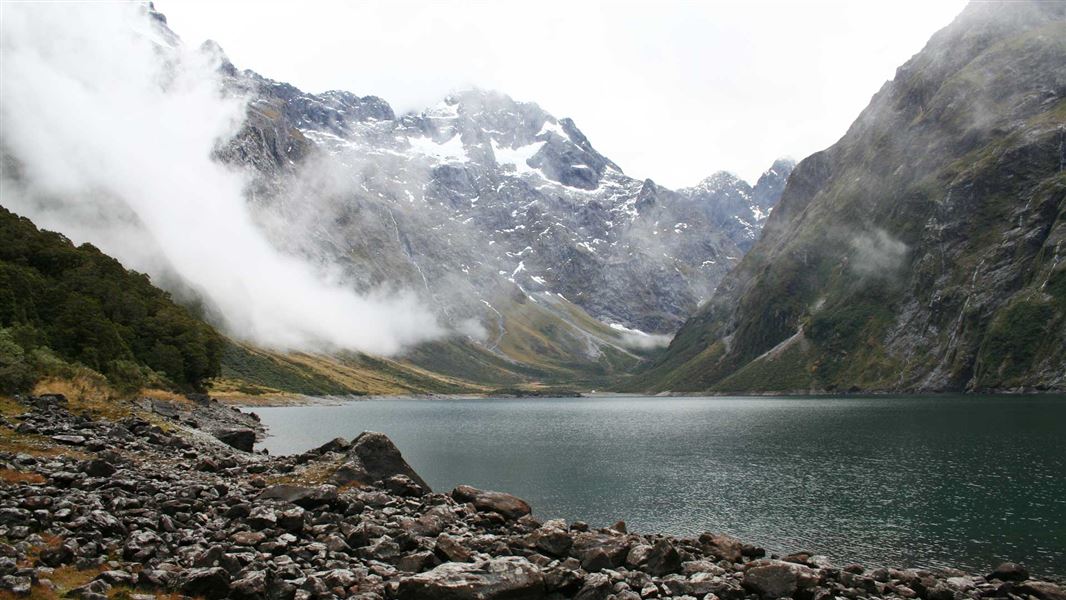
| Lake Marian Track | 3.1 kilometres one way, 1 hour 30 minutes one way, advanced | An alpine lake in a hanging valley; good fitness and backcountry skills needed |
| Gertrude Saddle Route | 7 kilometres return, 4 to 6 hours, expert | Alpine and navigation skills essential. DOC's rule: if there is rain or snow, don't go |
Want Key Summit with a guide?
This guided day hike from Te Anau starts at The Divide and climbs to Key Summit, by its own listing, the walk in the table above. The weather still decides the day.
06 / Wildlife and flowers
What wildlife and flowers can I see in summer?
Alpine flowers and kea near the Homer Tunnel, southern rata in flower and, with luck, tawaki in their moult.
No sighting is certain. Where DOC gives a season, we give it.
- Alpine flowers.
DOC says the Homer Tunnel area shows native flowers in summer once the snow has cleared, including alpine buttercups (called Mount Cook lilies) and daisies.
- Southern rata.
Visit Fiordland says to look out for the Fiordland Christmas tree, the southern rata, with its bright red flowers.
- Kea.
DOC says kea are often seen around the Homer Tunnel (watch your belongings), and lists the Routeburn, Key Summit and Milford tracks among places to see them. Never feed them: human food can harm wildlife and change its behaviour.
- Tawaki (Fiordland crested penguin).
DOC says the breeding season, July to November, is the time to see them, but they can sometimes be seen in the moult, mid-January to early March. They are very timid: do not approach birds, nests or beaches where penguin tracks are common.
- Forest birds and bats.
DOC calls the Eglinton valley a stronghold for native birds, including kākā and yellowhead/mohua, and says long-tailed bats are active around dusk and dawn along the Milford Road.
07 / What to pack
What should I pack for sandflies, sun and rain?
Insect repellent, sun protection and a rain jacket every time, plus water and food, because there are no shops on the road.
From DOC's journey tips and its gear lists for short walks and day hikes.
- Insect repellent.
DOC's Fiordland kayaking page says sandflies are prominent in all areas, and DOC warns there may be a lot on the Milford Foreshore Walk.
- Sun protection.
DOC lists sunscreen for the Milford Road; its short walks gear list adds a sun hat or warm beanie (pack one and wear the other) and sunglasses.
- Rain gear and warm layers.
DOC advises warm clothing and wet weather gear, and its short walks gear list includes a wind and waterproof jacket with a hood.
- Water and food.
DOC says there are no fuel stations or shops between Te Anau and Milford Sound. Its gear lists suggest at least 1 litre of water for walks under 3 hours, and 1 to 2 litres plus a packed lunch for day hikes under 8 hours.
- Care in the water.
DOC's swimming advice, for all of New Zealand: if in doubt, stay out; look for hidden dangers such as strong currents, cold water and submerged rocks; always go with a buddy.
08 / A summer day
How do I plan a summer day at Milford Sound?
Check the live sources, stock up in Te Anau, walk on the way in, reach the sound after 1.30 pm and cruise then.
- 01Check before you leave.
View DOC's Fiordland alerts and check the latest Milford Road status; DOC says roadside signs at Te Anau, Knobs Flat and Milford Sound give road updates, and Visit Fiordland points to the NZTA road status.
- 02Stock up in Te Anau.
DOC says there is no fuel or shop on the road. Toilets are at Te Anau, Knobs Flat and Milford Sound; mobile coverage is patchy, and in an emergency you dial 111.
- 03Walk on the way in.
Spend the busiest hours, 9.30 am to 1.30 pm, on walks along the road, such as Mirror Lakes, or Key Summit if you are fit.
- 04Arrive after 1.30 pm.
DOC's advice for avoiding the crowds. If you are cruising, allow time to park and reach the terminal (sources differ, as shown above).
- 05Get on the water.
RealNZ says a day cruise runs 1.5 to 2 hours on the water, out toward the Tasman Sea and back.
- 06Finish on foot.
Visit Fiordland says late afternoon and evening are among the best times to explore Milford in summer: try the Foreshore Walk for Mitre Peak, repellent in hand.