
- 1DOC dates Fiordland's European history from Cook's 1773 stay in Tamatea/Dusky Sound, which its pages give as five weeks or six weeks.
- 2The Milford Track's dates differ by DOC page: the memorial page says McKinnon and Mitchell discovered the route on 17 October 1888; the park page says McKinnon and Sutherland opened it up in 1889; the Milford area page gives no year.
- 3Road gangs finished the road from Te Anau to The Divide in the 1930s. Homer Tunnel work began in 1935 and ended in 1953 by Visit Fiordland's page or 1954 by DOC's.
- 4In the 1960s, DOC says, over 265,000 New Zealanders petitioned against raising Lake Manapouri, in one of the country's first major conservation campaigns.
01 / Start with the answer
What is the story of Fiordland since Cook?
Sealers and whalers after Cook, then surveyors, prospectors and track builders, then road gangs, a tunnel, hydro lakes and a campaign that won Lake Manapouri statutory protection.
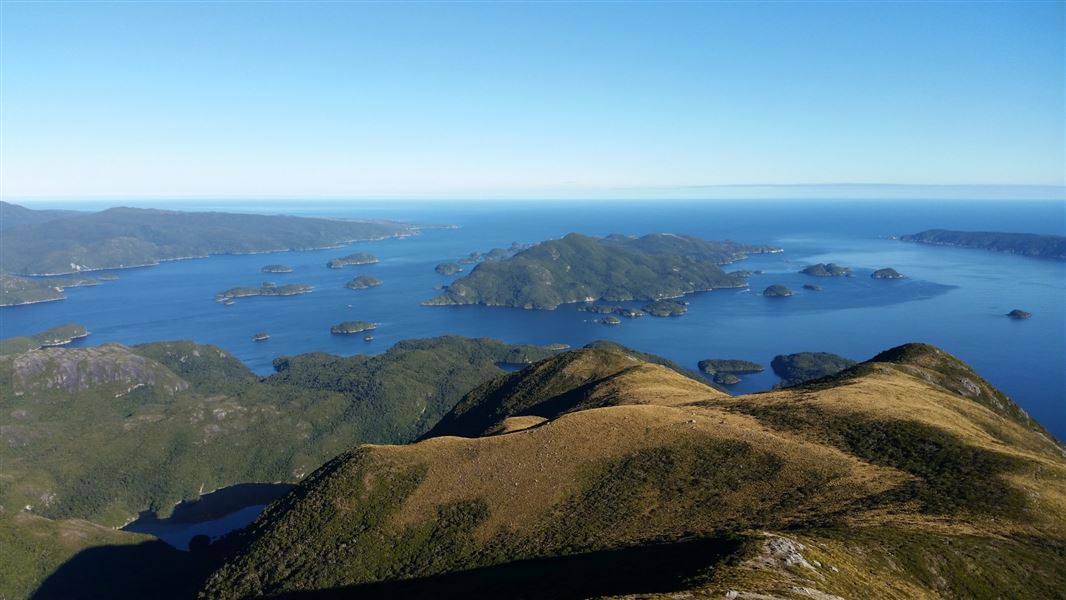
DOC says Captain Cook and his crew were the first Europeans to visit Fiordland, in Tamatea/Dusky Sound in 1773. Cook's maps and descriptions soon attracted sealers and whalers, who formed the first European settlements of New Zealand, and from the middle of the 19th century surveyors, explorers and prospectors began to go into Fiordland's unexplored interior. Preservation Inlet boomed briefly in the 1890s after gold was found, but DOC says efforts to set up mines, timber mills and farms in Fiordland have generally been short-lived. This guide follows the routes and works that came next: the Milford Track, the Milford Road and the Homer Tunnel, and the hydro lakes and the Borland Road in the south. DOC says Fiordland National Park was officially constituted in 1952. Where DOC's pages disagree on a date, this guide gives each date with its page. It covers European exploration and the works of the last century; Fiordland's Māori history is not retold here yet, because we hold those passages until they can be checked against Ngāi Tahu and DOC primary sources.
02 / Timeline
What happened when, by source?
From Cook's 'Dusky Bay' in 1770 to the Borland Road in 1963, with the page for every date.
| When | What happened | Source |
|---|---|---|
| 1770 | Cook sights the fiord on his first voyage and names it 'Dusky Bay' | DOC southern fiords page |
| 1773 | Cook in Tamatea/Dusky Sound: five weeks on three DOC pages, six weeks on one | DOC park, history, Astronomer's Point and southern fiords pages |
| 1862 | Surveyor James McKerrow spends eight days exploring Lake Manapouri in a flat-bottomed boat | DOC Lake Manapouri page |
| 1878 | Donald Sutherland builds three thatched huts he calls the City of Milford | DOC Milford area page |
| 17 October 1888 | Quintin McKinnon and Ernest Mitchell discover the route now famous as the Milford Track | DOC McKinnon Pass memorial page; DOC's park page also gives 1888 |
| 1889 | McKinnon and Sutherland open up the Milford Track and begin guiding tourists | DOC park page |
| 1889 | William Homer discovers the saddle now named after him | DOC Milford area page |
| 1890 to 1892 | A prison labour gang builds the last 3 km of the Milford Track, to Sandfly Point | DOC Milford Track page |
| 1891 | Resolution Island is chosen as New Zealand's first sanctuary | DOC Richard Henry page |
| 1892 | McKinnon is reported missing on Lake Te Anau | DOC McKinnon Pass memorial page |
| 1890s | Gold is found and Preservation Inlet booms briefly | DOC history and culture page |
| 1901 | The first red deer are released at the base of the Monument on Lake Manapouri | DOC Lake Manapouri page |
| 1903 | West Coast miners cut the track later followed by the Dusky Track between the Bishop Burn and the Henry Burn | DOC Dusky Track page |
| 1914 | A memorial cairn is built on Omanui/McKinnon Pass | DOC McKinnon Pass memorial page |
| 1926 | Lake Monowai is raised 2.5 metres for hydro-electric power | DOC Lake Monowai page |
| 1930s | Work scheme gangs complete the road from Te Anau to The Divide | DOC Milford area page |
| 1935 | Work on the Homer Tunnel begins | DOC Milford area page; Visit Fiordland |
| 1952 | Fiordland National Park is constituted | DOC history and culture page |
| 1953 or 1954 | The Homer Tunnel is finished: 1953 says Visit Fiordland, 1954 says DOC | Visit Fiordland; DOC Milford area page |
| 1960s | New Zealanders campaign to protect Lake Manapouri | DOC Lake Manapouri page |
| 1963 | Construction of the Borland Road begins | DOC Lake Monowai page |
The park today
Our Fiordland National Park guide gives DOC's figures for the park now, its gateways and its World Heritage status.
03 / The Milford Track
Who found the Milford Track, and in which year?
Quintin McKinnon, with Ernest Mitchell on the way in and Donald Sutherland at the Milford end. DOC's pages give 1888 for the discovery and 1889 for the opening, and one gives no year.
DOC's pages tell the story in slightly different ways, so here is each. DOC's Omanui/McKinnon Pass memorial page says the route from Lake Te Anau to Milford Sound, now famous as the Milford Track, was discovered by Quintin McKinnon and Ernest Mitchell on 17 October 1888. DOC's park page agrees on 1888 for the discovery, and also says McKinnon and Donald Sutherland opened up the track in 1889 and began guiding tourists. DOC's Milford area page says the track was cut by Sutherland and Mackinnon a dozen years after Sutherland built his huts, and gives no year. The memorial page says the Chief Surveyor of Otago commissioned McKinnon to blaze a track up the Clinton Valley and find a pass for tourist access to Milford Sound; Sutherland had already cut a track from Milford to Sutherland Falls. Richard Henry was the first to walk the track after its discovery, and over the next three years much of McKinnon's time went into improving it and guiding tourists. DOC's Milford Track page says a prison labour gang built the last 3 km, to Sandfly Point, between 1890 and 1892. McKinnon was reported missing in 1892. Lake Te Anau was searched and his wrecked boat found, but never his body, and he is presumed to have drowned. DOC says he spelt his name Quintin McKinnon, though it is written variously as Quintin, Quinton, MacKinnon, Mackinnon and McKinnon; it is on Omanui/McKinnon Pass, Lake McKinnon, the Quintin Huts and St. Quintin Falls.
04 / The City of Milford
Who was Donald Sutherland?
Milford Sound's first European resident, a Scottish sealer, soldier and gold prospector who built the 'City of Milford' in 1878.
DOC says Donald Sutherland, a Scottish sealer, soldier and gold prospector, was the first European resident at Milford Sound, and in 1878 built three thatched huts he called the City of Milford. His wife Elizabeth opened a boarding house at Milford for city visitors who came to enjoy Fiordland, called asphalters. Sutherland cut the track from Milford to Sutherland Falls before McKinnon's route arrived from Lake Te Anau. You can still walk towards his grave today: DOC's directions for the Milford Sound Lookout Track lead from the car park behind the café at Milford Sound towards Donald Sutherland's grave, a walk DOC lists as 400 metres return and 20 minutes.
05 / Road and tunnel
How was the Milford Road built?
William Homer found the saddle in 1889, work scheme gangs built the road to The Divide in the 1930s, and the Homer Tunnel took from 1935 to 1953 or 1954, by source.
DOC says William Homer discovered the saddle now named after him in 1889, and the road from Te Anau to The Divide was completed by government work scheme gangs in the 1930s. The Homer Tunnel took far longer. Visit Fiordland says construction began in 1935 and was not finished until 1953. DOC's Milford area page also says work began in 1935, but that difficult conditions and the Second World War delayed completion until 1954. Neither page explains the other's year, so we give both.
Travel the road and the tunnel
Three day tours from Te Anau take the Milford Road to a Milford Sound cruise, and each one's own listing describes the road tunnel on the way: when it was completed, how long it took to build, or its history.
06 / Lakes and power
What happened at Lake Manapouri and Lake Monowai?
Monowai became one of the first lakes controlled for hydro power in 1926; Manapouri was given statutory protection after a 1960s campaign against raising it.
DOC says the level of Lake Monowai was raised 2.5 metres in 1926, making it one of the first lakes in New Zealand controlled for hydro-electric power. Construction of the Borland Road began in 1963 to build and service a transmission line between West Arm Power Station on Lake Manapouri and Tiwai Point Aluminium Smelter near Invercargill. In the 1960s, DOC says, many New Zealanders protested and signed petitions to protect Lake Manapouri, in one of the country's first major conservation campaigns. Over 265,000 signed a petition against raising the lake for power generation; the lake was given statutory protection and its levels are now controlled to mimic natural fluctuations. Earlier, in 1862, surveyor James McKerrow spent eight days exploring the lake in a flat-bottomed boat and gave many of its place names. In 1901 the first red deer were released at the base of the Monument on Lake Manapouri, and DOC says they have spread across Fiordland from there.
07 / See it for yourself
Where can I see Fiordland's history today?
On the Lookout Track at Milford Sound, on Omanui/McKinnon Pass, at Astronomer's Point and Pigeon Island by boat, and on the Borland Road.
- 01Milford Sound Lookout Track.
DOC's directions lead from the car park behind the café towards Donald Sutherland's grave.
- 02Omanui/McKinnon Pass.
The memorial cairn, built in 1914 from stone collected on the pass, stands near the lowest part of the saddle, with a cross and plaque; DOC maintains it. Milford Track walkers cross the pass on day 3.
- 03Astronomer's Point.
DOC says it is in Pickersgill Harbour, Tamatea/Dusky Sound, reached only by boat, and is one of the most visited historic heritage sites in Southland.
- 04Pigeon Island.
Richard Henry's home, registered as a Category I Historic Place, reached only by boat with a tourist operator or your own vessel.
- 05The Borland Road.
Built for the Manapouri transmission line. DOC says it is unsealed, narrow and steep in places and not suitable for campervans, caravans or trailers.